


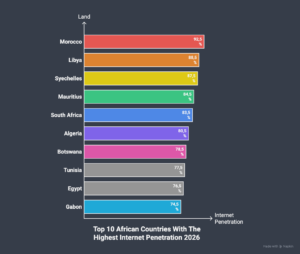
As Africa continues its rapid digital transformation, internet access has become one of the most important metrics of economic development, connectivity, and innovation potential. While overall internet penetration on the continent still trails the global average, several African countries stand out for their high levels of connectivity — driven by strong infrastructure, policy support, and widespread mobile adoption.
Here are the top 10 African countries with the highest internet penetration as we head into 2026 — and what makes them leaders in digital access.
1. Morocco
📍 Internet Penetration: ~92–93 %
Morocco consistently ranks as the most connected country in Africa, with internet access reaching nearly the entire population. This high penetration stems from widespread mobile coverage, affordable data plans, and strong digital policy initiatives.
2. Libya
📍 Internet Penetration: ~88–89 %
Libya’s high internet penetration reflects expanded mobile broadband coverage and a relatively large urban population with reliable connectivity. Although infrastructure faces challenges in conflict-affected areas, overall access remains among the highest on the continent.
3. Seychelles
📍 Internet Penetration: ~87–88 %
This island nation boasts one of Africa’s most connected populations, supported by strong tourism-driven demand for reliable internet services and robust telecom infrastructure relative to its small population.
4. Mauritius
📍 Internet Penetration: ~84–85 %
Mauritius ranks high not just in penetration but in overall ICT development thanks to sustained investment in digital infrastructure, public services online, and tech adoption across businesses and households.
5. South Africa
📍 Internet Penetration: ~83–84 %
South Africa’s internet ecosystem benefits from well-developed fixed broadband and mobile networks, with major urban centers like Johannesburg, Cape Town, and Pretoria leading connectivity and digital service adoption.
6. Algeria
📍 Internet Penetration: ~80–81 %
With improved telecom infrastructure and expanding 4G coverage, Algeria continues to grow its online population. Government digital strategies and investment in broadband have boosted national connectivity.
7. Botswana
📍 Internet Penetration: ~78–79 %
Botswana is emerging as a regional leader in digital access due to steady investment in network expansion and mobile internet adoption. Both urban and an increasing number of rural residents are coming online.
8. Tunisia
📍 Internet Penetration: ~77–78 %
Tunisia rounds out the high-penetration countries with strong ICT development and wide adoption of mobile internet, supported by competitive telecom markets and rising digital engagement across sectors.
9. Egypt
📍 Internet Penetration: ~76–77 %
Egypt benefits from a mix of a large, youthful population and robust telecom infrastructure, placing it among Africa’s leaders in connectivity — a key driver for its booming digital economy.
10. Gabon
📍 Internet Penetration: ~74–75 %
Gabon’s relatively high internet access rate reflects focused efforts to build digital infrastructure and improve network quality, especially in urban regions.
Honourable Mentions
While not cracking the top ten in overall penetration, several other African countries are rapidly expanding access and narrowing the digital divide:
-
Eswatini — strong ICT growth and adoption
-
Senegal and Cape Verde — mobile internet driving penetration growth
-
Nigeria — huge number of users, though overall penetration is lower than some smaller countries due to its massive population.
What These Rankings Show
Africa’s internet landscape is shaped by two overlapping realities:
📌 High Penetration ≠ Large User Base
Smaller countries often top penetration charts because a large proportion of the population has access. Larger countries like Nigeria and Kenya may have more internet users in total, but lower percentages of their population online.
📌 Mobile Internet Drives Connectivity
Across the continent, the expansion of mobile broadband — not fixed lines — is the primary driver of internet penetration. Smartphones and affordable data remain key enablers of digital access.